
Contents
DoW:CoP General Questions
Can DoW CoP be used for material deposits in a general agricultural setting?
No, unless it is for specific hard engineering works with a relevant planning permission and does not involve land raising or land re-profiling on land which is to be used for crop growth or livestock grazing. Read on for further context and explanation.
A number of sites have been brought to CL:AIRE’s attention by the Environment Agency where the Definition of Waste: Code of Practice (DoW CoP) has been mis-used to deposit materials in an agricultural setting. These projects are generally outside the DoW CoP scheme. This is made clear in the questions asked of the Qualified Person (QP) in the Declaration, where the QP has to specifically tick a check box that states the intended materials use does not include land-spreading / agricultural re-profiling.
Issues with Agricultural Reuse
There are reasons for these activities being out of scope, which are linked to holder intentions, current permitting requirements and the relevant tests in the Waste Framework Directive (WFD). Agricultural settings require very specific materials for land improvement, re-profiling or land raising. The agricultural setting, where assessment for materials suitability as an amendment to agricultural soils is needed, requires a particular skill set. This must include understanding of soil health and soil function in that specific rural setting. The specification of soils imports for such uses would need to include: field drainage characteristics, soil structure, biological activity, soil carbon, soil stability assessments and the potential for crop and livestock uptake as a minimum. None of these are part of the current DoW CoP materials suitability assessment process, which in the main is linked to reuse of materials on hard development sites or brownfield / infrastructure land. Nor do they lie within the current CL:AIRE QP’s area of specialism.
In addition, in cases brought to CL:AIRE’s attention, farmland has been used for projects where there is no substitution. This means the farmer has never had a business model or the finances available to show they can uplift or re-profile land, without the import of waste spoil where gate fees are charged to cover the activity costs. The Environment Agency has provided clear evidence of this activity in some cases in their investigations. These projects therefore cannot fit under DoW CoP, where gate fees could be taken as an indicator of a waste disposal activity.
These projects would fit better under land spreading permits or recovery permits, where proper, site-specific materials specification and soil assessment, linked to the permit requirements, can ensure the right materials are used for the activity in question. Importing multiple different loads of spoil, even if clean naturally occurring soils, from different sites, with different soil characteristics to the existing land and with different drainage and soil health characteristics cannot be suitable for the environment or even achieve the project goal if a different regime to the currently accepted permitting one is used in these settings.
DoW CoP can only be used in rural settings where there are specific development / engineering works being undertaken, such as building a slurry lagoon or a level platform for agricultural structures to be erected. It is not for re-profiling land with an arable or livestock end-use.
Updated 19 March 2025
Can the DoW CoP be used to import materials for reuse on golf courses?
Yes, with additional requirements: Golf course Receiver sites present a unique challenge for the DoW CoP. This is due to the typically large volumes reused, long project durations, and subjective course design which can result in questionable volume requirements. Following concerns raised by the Environment Agency / Natural Resources Wales, golf course projects will now be subject to additional checks during the Declaration preparation and submission stage and at Verification report submission.
The project team will be required to have notified the local Environment Agency / Natural Resources Wales waste team of their intent to use DoW CoP for the import of clean, naturally occurring soils, and have allowed 21 days for comment. This is therefore different to other projects using Direct Transfers, which operate on the usual liaison requirement confirmed in Table 2 of the DoW CoP (page 20). The Qualified Person (QP) must review the regulator correspondence and reference this in the Declaration. The Declaration short name should clearly reference the golf course end use. Further, the project team must ensure the Environment Agency / Natural Resources Wales waste team is updated on the project importation progression every 12 months.
These checks have been brought due to some poor performing sites which have:
- not been fully tracking materials imports;
- had discrepancies in Donor site records;
- had material volumes and type not compliant with the original Materials Management Plan specification; or
- included materials that are not clean naturally occurring materials.
It is hoped that this review process and future developments will ensure good practice, as required for use of the DoW CoP, and enables golf course projects to continue making use of the scheme to reuse suitable materials for these types of engineering earthworks.
Can colliery spoil be reused under the DoW CoP?
Colliery waste materials generated subsequent to the Mining Waste Directive (MWD) (2006) are outside the scope of the DoW CoP (see paragraph 1.11 of the DoW CoP). Historically generated materials are not covered by the MWD and may also fall outside use under the DoW CoP. It is generally the case that materials termed colliery spoil[1] can include overburden and mixed geology excavated as a part of the process of winning coal. Colliery spoil can also include coal processing wastes which may have been placed on the site of origin or on nearby sites as backfill after the mining process was completed.
Certain materials associated with collieries might be eligible for reuse under the DoW CoP:
- overlying soil materials;
- where the colliery spoil forms a minor component of the soil and stones materials that are to be reused, and the materials are otherwise within the scope of the DoW CoP;
- materials on the colliery site that are simply an overlying natural bedrock with no coal materials.
Agreement with the Environment Agency or Natural Resources Wales must be sought in a recognised customer engagement process and full requirements of the DoW CoP must be met. If formal responses are not received from engagement within 21 days, then under published customer engagement policies it can be assumed there is no objection to the specific materials reuse if the engineering works are also approved formally under the planning regime.
Where colliery spoil heaps pose a serious risk to the environment or human health due to instability, a reprofiling of materials may be required to reduce the stability risks. The mechanism to achieve reprofiling may include DoWCoP reuse of spoil materials on site of origin approach where this is agreed formally with the relevant regulator in writing.
[1] Colliery spoil is a colloquial term which refers to the materials in the sedimentary strata that are associated with the coal seam, but which are not the coal seams themselves, or are generated by processing the coal, i.e., burnt shale. Spoil on colliery sites (like many other naturally occurring geologic materials exposed to the environment) can include heavy metals and other contaminants that can be harmful to human health and the environment, including animals and flora making it unsuitable for certain uses. Combustible materials, which may be present, such as coal and other organic matter can, via a process of oxidation and heating, lead to spontaneous combustion and underground fires.
Colliery spoil materials can also be subject to erosion and instability, especially if it is not properly managed or stabilised.
Can stockpiles of soil be used on Donor or Receiver sites?
Whether soil stockpiles can be used under DoW CoP is an issue that is frequently raised by users and regulators. Who decides the correct approach is sometimes difficult to determine, but it is easier if one always comes back to the “is it waste?” question and then thereafter what available routes can be followed.
Waste is something that a holder of a material discards, intends to discard or is required to discard. So, stockpiling materials should be looked at in that context.
Examples of Poor Practice
If a site is discarding materials from the outset, the materials are likely to be deemed waste. An example would be a project which plans to carry out excavations to create a basement for a new development. The site is tight for space and there has been no forward plan to find an option to reuse the material anywhere in the project timeframe. The holder just wants the material off-site after the initial excavation and stockpiling at the loading area. This is an indication it is being discarded, so this material is waste and must go, via an authorised waste carrier, to a permitted site. Alternatively, if it is only a small quantity and it meets the requirements it could go to a site with a registered exemption. This material / waste must be removed under the Duty of Care.
If there has been no plan in the project design stage to identify material which could be beneficially used elsewhere, and the material surplus to site requirements is temporarily stockpiled during works ready to be removed from site at the end of excavation works, then there is an apparent intention to discard and hence it is a waste.
The above two examples could be deemed poor practice in material management. The waste hierarchy has not been fully, or properly considered, and excavated material has been stockpiled with no effort to find an option to recover, or reuse the materials excavated. It is being discarded and sent off-site to get it out the way and the project is paying to have it removed.
If material is excavated and there are unexpected issues associated with it (i.e., it has unexpected contamination or poor geotechnical properties), and it is temporarily stockpiled, but the planning requirements or regulatory advice states it must be removed from site, then there is a requirement to remove the material and it is waste and should be treated as such and removed by a registered carrier to a permitted site. It is required to be discarded.
Examples of Good Practice
However, good project management and a genuine intention to have regard to the waste hierarchy from project outset can position the material in a different light. The key issue is “intention.”
A project demonstrating intention not to discard is likely to have several lines of evidence to support this claim. For example, at the design stage, a site excavated Materials Management Plan (MMP) would be in place. This would be informed by a good desk study, site sampling and risk assessment process. Prior to any excavation, the volume and type of materials to be excavated will be known. The site design strategy and MMP document will clearly state the intention to find a way to reuse or recover all the excavated materials.
In this case if material is stockpiled after excavation and stockpiles are managed in accordance with good site practice then this material can be held on site for up to 12 months. The material may be surplus to Site of Origin requirements, but there is not an intention to discard it, as clearly demonstrated in the MMP. A further line of evidence may be that the materials have been registered on the CL:AIRE Register of Materials. When a Receiver Site is identified for this material, it can be moved off-site to the nominated Receiver Site under DoW CoP. Alternative reuse options could also be as waste materials to an exempt site, providing it meets the exemption criteria, or a permitted recovery site.
Clear lines of evidence are required showing how much material will be excavated, what type of material it is, stockpile management so as not to cause any problems (runoff, dust, eyesore etc.) and where it is intended to go. A genuine attempt to identify potential Receiver Sites must be made before excavation and stockpiling. If Receiver Sites are not identified for all the material, this may not be a fundamental problem, providing all lines of evidence regarding intentions are present and efforts to find Receiver Sites can be clearly shown. The above may also be required under planning in a Construction Environment Management Plan (CEMP).
It is important to note that material stockpiled with an intention to find a Receiver Site for beneficial reuse in this way can only be stockpiled for up to 12 months, under the relevant exemption for storage of material at site of production. Storage for longer may require a waste storage permit, or at the very least formal confirmation from the regulator of an agreed extended period beyond 12 months. This will only be a limited extension, but the maximum for larger projects may be up to three years if the material is intended for reuse or recovery.
Any material stored for longer than 12 months in a stockpile, where there is no clear intention stated to reuse, is likely to be considered waste and must be removed from site under Duty of Care to a registered waste recovery or disposal site. This material is not to be accepted at a DoW CoP Receiver Site and QPs must not sign Declarations that include such material.
Stockpiles at Receiver Sites
The above considerations also apply to stockpiles at Receiver Sites. If material is imported under the DoW CoP and stockpiled, but not used within 12 months, or in a time period agreed with the regulator, it will be considered waste and any subsequent material reuse may require a waste permit for recovery or disposal, or else the material must be removed from site as waste.
The key issue is whether there is an intention to discard, either deliberately, or by default. For example, if a multiphase project has surplus soil arisings on phase 1 and they are stored with intention to be reused under phase 3, but after 12 months they have not been transferred or used, it can be considered abandoned and potentially an illegal waste deposit.
Potentially this material, if covered by a soil stockpile management strategy, may be stored for longer with agreement from the regulators, either on phase 1 or even phase 3, but there must be clear intention for reuse and the materials must be kept suitable for reuse by good stockpile management. Any potential for them to be deemed abandoned by regulators could result in material becoming waste which could result in penalties incurred for an illegal deposit of waste. Such deposits may also be subject to landfill tax penalties and charges.
Recommendations
Good document management is imperative, with high quality and full lines of evidence, relevant agreements with the regulators, and compliance with all good practice guidance and regulatory requirements. There must be ongoing oversight, along with good materials tracking systems.
Conversely, ad hoc material management, stockpiling with no clear intentions, last minute arrangements for material transport and poor attention to timelines and project management will restrict options for material reuse and disapply options like DoW CoP, with possible enforcement actions applied to abandoned or illegally deposited materials.
Watch Point 15 (Materials use at Receiver sites): When does it apply, and how should it be considered?
The principles from which Watch Point 15 (on page 31 of DoW CoP) are derived apply to all projects using the DoW CoP, so it is important to understand what information is required to ensure it is complied with.
Although often discussed in the context of Cluster sites using brownfield soils, Watch Point 15 is equally relevant to Direct Transfer projects. The reuse of materials with naturally occurring contamination needs to be assessed and properly understood under Direct Transfer projects.
Watch Point 15 derives from the Waste Framework Directive (WFD) principles that sites must not be further degraded (in relation to Human Health and/or the environment) by import and reuse activities at Receiver site(s).
Watch Point 15 therefore requires transfer projects (e.g. Cluster and Direct Transfer) to not just assess materials being moved and establish their contaminant profile, or the potential presence of greenfield contaminants such as recalcitrant pesticides. It also requires a baseline understanding of the current status of the Receiver site. As confirmed in the DoW CoP training, naturally occurring contaminants taken from one setting to another can have significant impacts on sensitive Receiver site settings if not properly characterised and understood. This means some level of environmental sampling is required to understand the baseline at the Receiver site and compare this against any import materials test results. The level of testing will depend on soil type and homogeneity within the excavated materials at Donor sites and at the Receiver site deposit areas.
It is not acceptable under the WFD requirement to say that the imported material meets a relevant land use criteria and so is acceptable. Watch Point 15 requires that no degradation occurs to land quality. This means it is not just about risk-based criteria for the Receiver site, it is about benchmarking against the natural site baseline and any discrepancy over that in proposed import materials. Using site-specific risk-based criteria is appropriate for the Site of Origin context, for either anthropogenic or naturally occurring contamination. However, for material transfers to third party sites, the Receiver site baseline must also be used as a relevant benchmark to set import criteria. See diagram below for Watch Point 15 contaminant levels, as shown in the DoW CoP training.
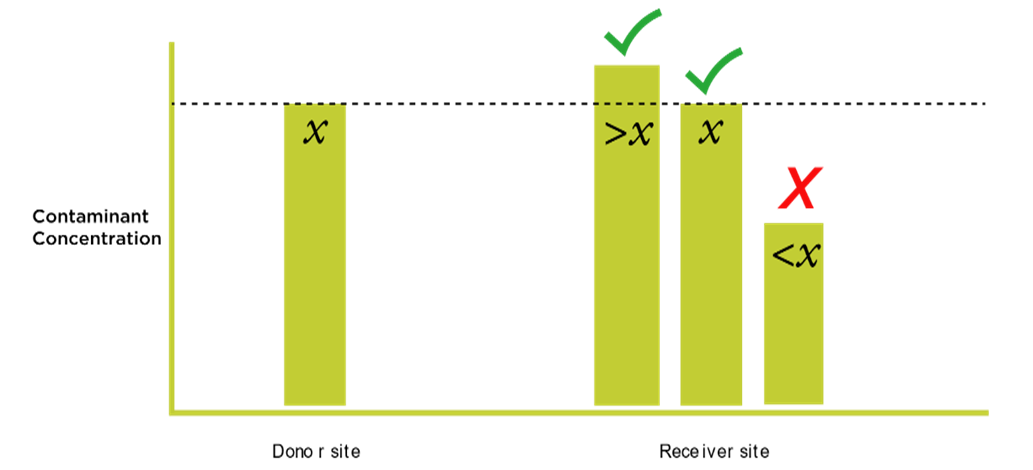
Imported materials must also have regard to source mass as causing an increase in the mass source term at the Receiver site would result in an overall degradation of the site conditions.
No new contamination can be introduced to a Receiver site. This may be especially important for Donor sites with potential emerging contaminants of concern, which may not have previously been part of standard testing suites, such as materials from areas of grassland i.e. airports grounds or fire station premises, which may have been impacted by firefighting runoff.
Therefore Qualified Persons must ensure where materials are transferred, including those using Direct Transfers from greenfield sites, that projects have a proper understanding of Watch Point 15 requirements. Baseline assessment of Receiver sites must be presented as well as appropriate risk assessment to provide a control for any imports.
Can DoW CoP be used for quarry backfilling?
Whether the DoW CoP can or cannot be used to backfill quarries is a question that must be considered on the specifics of any proposed backfill operation.
As outlined in the Definition of Waste Code of Practice Training, generally, for activities involving the backfill of quarries, it is unlikely the DoW CoP will be the right mechanism to deposit materials to restore the land to original pre-extraction levels (especially in large volumes). This will generally be determined in the first instance by the planning permission originally granted, i.e. many planning permissions for mineral extraction and related activities are applied using minerals and waste planning local plans. These often stipulate where mineral workings are available and restoration of these sites should use waste materials to backfill voids under a relevant landfill permit.
Where large voids will require significant high volumes of potentially mixed wastes, and the long-term impacts of infill should be monitored due to the hydrogeological setting, it is right that an environmental permit, with its protective engineering requirements and monitoring should be employed to cover backfill activities.
The permitting approach also enables commercial arrangements to be brought into play to cover some of these engineering and monitoring costs. Planning requirements and consultation responses to the planning application process will often make it clear that a landfill for waste is to be the suitable management route for quarry backfill activities. In such cases, an Environmental Permit for Recovery or Disposal is required from the relevant regulator. Therefore the parameters of a granted planning permission for the mineral site and subsequent backfill activity are key, as well as consideration of planning consultation responses from the relevant regulator.
However, there may be some backfill activities in old mineral workings that are able to use the DoW CoP for limited materials placement activities, such as the following:
· where the overall void is not being infilled but cut and fill activities are being used to re-landscape the quarry floor profile to create relevant future use settings.
· hard development such as warehousing, business estates, shopping centres and similar construction projects.
· low-level restoration to form habitat creation schemes such as scrapes, lakes, ponds, and wetlands, or for different mosaic soil conditions for biodiversity net gain for instance.
· the creation of sandy banks for bird nesting sites perhaps to enhance existing cliff faces, or to create more safe, stable landforms.
· engineering works to stabilise dangerous cliffs, with toe base deposits to support unstable slopes.
These engineering activities should be carried out under a relevant planning permission for the stated purpose, and may be within the scope of the DoW CoP, providing all the other requirements of the Code are met in full.
The activity must not be a fee-earning deposit activity carried out to enable disposal of waste materials from other sites, that are discarding surplus materials, even if those materials are inert soils and stones.
So, for quarry backfill projects, it is critical that the relevant planning permission frame is understood. The scale of activity must be appropriate, and the relevant consultees must have given approval before any project uses a DoW CoP approach to undertake limited backfill activities in a quarry site setting. Where DoW CoP can be used in principle, all the requirements of the Code must be met in full, and the project managed to achieve the stated aims under the granted planning consent for limited backfill activity.
Published 27 Jun 2024
What is a DoW CoP Site of Origin?
This can include the area covered:
• By a specific Planning Permission red line boundary.
• By a single detailed Remediation Strategy / detailed Design Statement.
• By an agreed Environmental Permit Deployment Form.
• Other, as agreed with the relevant waste regulators e.g. separate sites close to each other assembled to form a single development scheme , undertaken by the same developer. Agreement with the relevant regulator means this must be evidenced, even if separate parcels of land, or phases of the development are falling under Route B transfers of clean naturally occurring materials.
To align with good practice demanded by the DoW CoP, decisions about defining the Site of Origin for a specific development need to ensure sustainable solutions are achieved in any remediation or earthworks. This can be done by taking into account the principles of the Sustainable Remediation Forum – UK (SuRF-UK) i.e., environmental, social and economic principles, and more generally the Circular Economy aims and objectives for construction activities. Decisions can be guided by what is covered in any overarching outline planning permission for the specific development in question. Consideration should also be given to the Aims & Objectives of the Waste Framework Directive, e.g. the protection of human health and the environment. As the size of the Site of Origin increases, it follows that the risk of undermining this objective can also increase.
For instance, on a long linear project, it may be sensible to separate the site into different sites of origin based on; environmental sensitivities or coherency, contractual arrangements, geographic/geological units, the presence of contamination (anthropogenic or naturally occurring) of different parcels of land, or the timing of work packages . This is similar to the principle for determining how many MMPs are required for a specific large-scale project. Sites where substantive distances are involved for transporting materials between donor and receiver areas are usually better managed under Direct Transfer or Hub and Cluster arrangements unless it can be argued effectively that the alternative is the more sustainable option.
The MMP and Declaration should clearly identify how the Site of Origin has been decided if more than one area, phase, or site is included in a Site of Origin scenario, as outlined above.
Published 27 Jun 2024
Which team in the Environment Agency will carry out the Audits?
Audits will be arranged by the relevant National Environment Agency team and carried out with assistance of local Area staff. Staff carrying out audits will be fully conversant with relevant waste legislation and the content and aims of the DoWCoP. For consistency purposes any queries on interpretation including issues such as bulking and consolidation will be resolved in consultation with the National team.
How long after submission of a Declaration might the Environment Agency carry out an audit? (Concern was expressed that if undertaken 5 years after completion and some problem is found, then there may be houses on what might be classified as a waste site.)
Most audits will be undertaken within 6 months of the submission of a Declaration. However audits can be triggered at a later date if complaints are received about a site or a pollution incident is subsequently reported. A risk based decision will be taken as to whether to retrospectively enforce the requirements for an environmental permit if problems are found at any site.
Can the DoW CoP be applied to fixed Soil Treatment Facilities?
Could the DoW CoP be used to bring material such as Pulverised Fuel Ash (PFA) on to a site, for example a former mine.
Potentially: The Pulverised Fuel Ash would have to constitute made-ground and be excavated and re-used as earthworks materials as part of a defined Hub and Cluster development. However the filling of mineral voids is commonly regarded by the Environment Agency as a landfilling activity which would rule out the use of the DoW CoP.
What about the case where impact to groundwater remains after human health issues are dealt with, but Environment Agency takes the view that it is unreasonable to require further work (e.g. aquifer already compromised). Would the material strictly not be suitable for use?
Suitability is determined on a site by site basis with reference to the achievement of agreed risk based targets which take into account the environmental setting of the site.
Why does the methodology behind the assessment of “suitability” differ when considering the three scenarios of use on Site of Origin, Direct Transfer and Hub & Cluster within the DoWCoP? Why isn’t suitability defined by a simple risk assessment at the site of use?
Article 14 of the Waste Framework Directive requires necessary measures to be taken to ensure that waste is recovered or disposed of without endangering human health and without using processes or methods which could harm the environment, and in particular:
- without risk to water, air or soil, or to plants or animals;
- without causing a nuisance through noise or odours;
- without adversely affecting the countryside or places of special interest.
In assessing the suitability of materials (and hence waste status) one has to consider not only the circumstances in which they arise but also the circumstances in which they are to be used. When considering “Site of Origin” scenarios, an acceptable level of risk to the environment is defined in the context of the sites current/baseline condition. This enables the re-use of otherwise contaminated materials on the basis of waste minimisation; land quality is being maintained or enhanced, thus achieving the objectives of the Waste Framework Directive.
When considering the importation of foreign materials to a site it is important to ensure that the materials will be used in a way that achieves the same goals. If materials were imported to a site so that new hazards were created, or existing hazards increased the net effect would be to increase the level of risk posed to human health and the environment. This would be contrary to the objectives of the waste framework directive. It should be remembered that land-use can and does change over time meaning that any new hazards created by importation of materials will have to be dealt with in due course. The net effect is that land quality would have been degraded rather than maintained or enhanced; this is not considered sustainable.
The differential between the costs of disposal of hazardous vs. non-hazardous materials also make it attractive to criminals to undertake “sham recovery” operations whereby the development itself is secondary to the profits to be made in circumventing legal controls on disposal. By providing clear guidance in the DoWCoP regarding such matters the Environment Agency hope to dissuade its potential exploitation in this manner.
How should I approach the assessment of chemical suitability in Cluster Projects given the restrictions imposed on reuse highlighted in Watchpoint 15?
The following simple approach can be used to ensure that you do not inadvertently introduce new hazards to a receiver site OR significantly increase the hazards that are already present:
- Define the quality of the material you need at your receiver site by reference to a site specific risk assessment as normal. Remember that in order to be suitable, materials must not cause pollution or harm to human health / environment (including controlled waters) at the location where they are to be used.
- Check whether the values derived would fall above the current thresholds used for hazardous waste classification purposes.
- If any of the values are above these thresholds then alter the materials specification to limit the allowable levels of these substances to below the thresholds.
In most cases this conservative approach will be sufficient to prevent the importation and reuse of materials in a way that the Regulator may consider to be “Sham Recovery”. It should also prevent the inadvertent creation of any significant problems for any future regeneration of the site.
In the unlikely event that the concentration of some substances at the receiver site are already above the hazardous waste classification thresholds but are not posing any unacceptable risks (as demonstrated by your site specific risk assessment agreed with the regulators), then raise the issue with the Environment Agency when seeking approval for the Cluster Project. In exceptional circumstances you may be allowed to import materials with levels of substances equal to or below the levels already existing at the receiver site. To do this the Environment Agency will need to be satisfied that the proposal is not unnecessarily substituting hazardous materials for non-hazardous alternatives (i.e. Sham Recovery).
Why is there not a short form Materials Management Plan for small volumes of lower risk materials?
The new Materials Management Plan form is designed to be used for all scenarios covered by the DoWCoP. Not all fields within the form need to be completed for every scenario.
Why is the term ‘adequate site investigation’ used over ‘ground investigation’?
Version 1 of the DoWCoP stated “comprehensive Site Investigation” which was considered too onerous for every site, for example at some sites no investigation would be necessary. However, in other situations more than just a Ground Investigation will be required e.g. Desk Top Study, therefore the steering group suggested the term “adequate Site Investigation” as an appropriate compromise.
Does the Qualified Person need to check that the treatment contractor has appropriate licences in place?
Yes (see Box B of the DoWCoP)
Does placing of material beneath cover layers amount to discarding of waste?
Material placed beneath buildings and hard standing such as car parks and roads within the land being developed is not waste, if the material is demonstrated to be non-waste by evidence of suitability for use and the works are carried out in accordance with the requirements of the CoP.
Where there is any dispute regarding the use of material in this way then readers are referred to the Environment Agency guidance “Defining Waste Recovery: Permanent Deposit of Waste on Land”.
Is material a waste if it is placed in or on the ground and has to be contained to prevent harm to human health or the environment?
Where excavated material is not suitable for the proposed use it will be waste and hence the CoP will not be applicable. For example if the material has to be placed in an engineered cell and managed to prevent harm to human health or pollution of the environment then this would be viewed as having been discarded as waste. This will be a landfill and require an environmental permit. There is a distinction between this scenario and that relating to cover layers above.
Why does the Code of Practice make no distinction between contaminated and uncontaminated material?
The need to distinguish between “contaminated” and “uncontaminated” soils is no longer considered necessary. These are self-defining terms on a site specific basis having regard to the risk assessment, e.g. some soil may not be considered contaminated for a given land use, but would be for a more sensitive land use, on the same site.
Is recovered aggregate a waste if it is produced in accordance with the WRAP
No it is not likely to be waste. Typical uses of recovered aggregate include pipe-bedding and selected backfill to sewer excavations; carriageway sub-base construction; and the construction of vertical, granular filled drains to aid consolidation of compressible clays.
Is the installation of a barrier to prevent groundwater movement or contain contaminants a waste activity?
Bentonite slurry cut-off walls: Bentonite / cement slurries are used to construct vertical barriers in the ground to prevent groundwater movement or to contain contaminants.
Depending upon the site-specific circumstances, this would either not require an Environmental permit or may comply with the EA Enforcement Prosecution Policy Functional Guidelines. Reference should be made to the EA Remediation Position Statement Guidance for details.
Are soil improvement techniques treatment activities and do they require a permit?
Construction activities carried out on uncontaminated soils solely for the purpose of improving geotechnical properties are not generally regarded as waste treatment operations and do not require a permit. These include:
- Lime/Cement Stabilisation: Stabilisation of soils with high moisture content to improve their compaction characteristics by mixing with lime-cement or cement only. If the lime is considered to be a waste material, or if the treatment is required specifically to recover a discarded material this may need to be reconsidered.
- Vibro Compaction: Vibratory techniques to improve the bearing capacity of weak soils (often made ground).
These techniques use a vibratory poker that is lowered into the ground under its own weight. In most cases, stone is introduced into the ground either down the centre of the poker or into the hole when the poker is removed. The poker applies further compactive effort until adequate resistance is achieved. The combined affects of the vibration and the introduction of the stone result in an increase in the density of the soil and a consequent improvement in bearing capacity. This activity must be carried out in accordance with requirements of the EA published guidance "Piling and Penetrative Ground Improvement Methods on Land Affected by contamination: Guidance on Pollution Prevention. NC/99/73". - Dynamic compaction: This technique involves dropping a heavy weight from considerable height to compact weak soils (often made ground). A series of ‘footprints’ are formed which are subsequently filled with granular fill. This may either be a primary aggregate or a re-cycled material. Dynamic compaction is not a waste treatment activity (unless it is being done on a landfill site for example) and any risk to controlled waters must be addressed during the assessment of the Planning permission.
- Surcharging: This technique involves placing soils in a mound to compress weak soils thus reducing future settlement potential. If the material used for the surcharging is generated and then reused (in line with the CoP) on the site it should not require a WFD permit or Exemption. However if the material is to be imported or exported from the site after use there may be requirements for waste permitting.
- Piling: There are various forms of piling which are used to transfer structural loads through weak soils to more competent materials at depth. These range from driven displacement, bored and continuous flight auger bored piles. A WFD permit will not be required for this activity. The piling activity must be carried out in accordance with requirements of the EA published guidance "Piling and Penetrative ground Improvement Methods on Land Affected by contamination: Guidance on Pollution Prevention. NC/99/73".
- Soil Reinforcement: This technique involves the introduction of geo-textiles or ‘geogrids’ to layers of soil (often made ground) to improve load distribution and bearing capacity. This technique is also often applied to improve the slope stability of soils to facilitate construction of steep sided embankments. A variation, to improve the stability of cuttings, is the use of ‘soil nailing’ whereby rods are ‘fired’ into the ground at regular intervals.
Clarification on the requirements of Table 2 and especially for response to Qs13
In certain DoW CoP scenarios liaison with the regulators is either required or the most appropriate option. This liaison DOES NOT require the EA or NRW officers to assess / read / approve MMPs. It provides an opportunity for projects to flag the sites intentions to use the DoW CoP and for the regulators to share any concerns they have about the site, operator or neighbourhood.
For reuse on Site of Origin of non-naturally occurring materials the EA / NRW do their responses through the normal planning matrix process on reports, remediation strategies etc. EA / NRW Waste teams and / or GWCL teams should just check, if treatment is involved, that a MTP is deployed appropriately.
EA / NRW Waste officers do not always require consultation for direct transfers of clean naturally occurring materials between two sites, if there is a clearly referenced desk study or site investigation report which confirms the site has no previous contamination issues. The QP is required to review and confirm this by providing the document reference in the Declaration.
Consultation is required for Cluster projects to agree the donor sites and receivers sites ahead of any transfers. This is just agreeing the sites, location and timeframes NOT the MMPs. The regulators may ask to see MMPs if they so wish.
Will I receive a refund for a cancelled declaration?
Our work starts as soon as a declaration is submitted and therefore we do not offer refunds for cancelled declarations.
DoW CoP Portal
DoW:CoP Aggregates Protocol
The DoW CoP scope excludes “excavated infrastructure material such as pipework and storage tanks” Does this exclude the use of excavated infrastructure such as road bases, car parking areas etc…? And if this is the case will operators need to use the DoW CoP and the WRAP Aggregates Quality Protocol on the same site?
The Environment Agency’s concerns centre on potentially polluting substances that can be associated with infrastructure e.g. pipes and tanks that may have residue products within them, concrete with adhered asbestos etc…. Other excavated infrastructure can be reused under the DoW CoP on the Site of Origin and receiver sites within a Cluster. If fully complied with the Aggregates Protocol allows for inert materials to be used at any site, including those currently not within the scope of the DoW CoP.
Why did a DoWCoP emerge from this process rather than a BREW Quality Protocol for soils?
BREW looked at this, but it was felt that the inherent multifunctionality elements of the programme contradicted the Government's suitable for use and risk based approach. The recommendation from that work was to build upon the Environment Agency guidance “Definition of Waste: Developing on Greenfield and Brownfield sites”, which the DoWCoP does. There is no single definition of what is "clean" that can be provided for soil that would allow it to be used at all sites and in all circumstances, unless of course it is inert and linked to a Quality Protocol.
DoW:CoP Qualified Person (QP) Questions
I trained and was registered as a Qualified Person under version one of the Definition of Waste Code of Practice. Can I re-register as a Qualified Person for the current version of the DoWCoP?
No. Individuals will, as of January 2013 be expected to attend the one day training course again. This is required due to the amount of time which has passed since the versions changed.
For the on-site reuse scenario the Qualified Person submits the Declaration to the Environment Agency and then excavation begins. For Cluster projects the Environment Agency still wants to agree the point that treated materials cease to be waste on a project by project basis.
- At what point in the process should these discussions take place?
At project planning stage. - Who is the point of contact?
Enquires should be directed to the local Environment Agency office in the first instance. Where a Cluster project straddles Environment Agency area boundaries then the area where the Hub site is located should be contacted. Assistance will be given by NTS – Geoscience team if required by the local team - What information needs to be submitted to get this agreement?
A Material Management Plan covering the sites concerned which contain the lines of evidence such as Hub site permit, contractual interrelationships and responsibilities, mass balance calculations etc. (also see paragraph A3.14 - DoWCoP Version 2)
What is the distinction between reviewing and checking (in the context of Qualified Person actions)?
Reviewing in this context means making sure that all documents are there and that e.g. risk assessment conclusions align with specification and the Remediation Strategy. Checking means working through the risk assessment, for example, to check that conclusions are right – this is deliberately not required in the DoWCoP as the Qualified Person would be straying into territory of others. The Steering Group did not want to have work paid for twice and did not want confusion in relation to roles and responsibilities. It was a deliberate decision to limit the role of the Qualified Person and hence liabilities remain as they were before the introduction of the DoWCoP.
Does the Qualified Person just check the existence and conclusions of the Risk Assessment not the detail?
Yes. The role of the Qualified Person is deliberately limited to that set out in the DoWCoP. If the Qualified Person was to come across any fundamental error in any of the documentation (this is not just restricted to the Risk Assessment) then it is expected they would raise the issue with the person who commissioned them as a Qualified Person. However that would be done outside of the requirements of acting as a Qualified Person.
Contracts can be extremely large, to what depth should they be reviewed?
The expectation is that the person commissioning the Qualified Person should provide a summary which only details the parts relevant to the DoWCoP. It would be prudent for the Qualified Person to provide a pro-forma / questionnaire to the employer setting out what aspects need to be presented e.g. roles and responsibilities of the various parties relating to the reuse and treatment of excavated materials, contingency arrangements etc...
How long will the process (production of Declaration) take and what will it cost?
This will depend on the complexity of the project, how the information is to be presented and the market rate of the individual Qualified Person.
How rigidly will the DoWCoP Qualified Person requirements be applied e.g. will there be flexibility if someone has more than adequate experience, but is not chartered?
Chartered status is required. Experience and chartered status are tackling two different aspects. Chartered status supports the statements made in the DoWCoP relating to self-regulation and a high level of professional integrity. That is not to say that the criteria may not change in the future following a sufficient period of the DoWCoP being used.
Note that in terms of experience Qualified Persons should have a track record in site investigation / remediation and waste management issues.
Can a Specialist in Land Condition (SiLC) act as a Qualified Person?
Yes provided that they attended a recognised training course, and meet the other requirements, such as registration set out in Appendix 6 of the DoWCoP.
The DoWCoP (Appendix 6) states that the Qualified Person should not be directly involved in the management or execution of the project. Is it acceptable for the Qualified Person to have had some direct role in the early stages of the project (e.g. management of site investigations or setting up the project under planning) and equally – could a Qualified Person become involved in project management or execution once the Declaration is completed and signed?
There should be no possibility of Qualified Persons checking their own work. As such, it is considered that any direct involvement in the initial stages of the project, or its establishment, will exclude someone from acting in the Qualified Person role on that project.
Once the Declaration is completed, signed and submitted, the Qualified Person role is finished and that person could go on to take a direct role in the management and execution of the project. Note, however, that in a Cluster project, there may be a number of Declarations to be completed and also the possibility of adding to that number if further sites join the Cluster. If the Qualified Person has become involved in the management and execution of the Cluster project having completed the initial Declaration(s) then a new Qualified Person will be required to deal with such additions.
If there is no hope of recovery of materials and it is definitely going to be classified as waste, is there merit in notifying the Environment Agency centrally of a “nil Declaration”
No. The system has been established for those who intend to operate under the DoWCoP and recover excavated materials.
What happens to Declarations when received at CL:AIRE?
All Declarations are added to CL:AIRE Declaration management system. Submissions are checked for mistakes or missing entries. Once all required information is included, CL:AIRE issue a Declaration receipt to the Qualified Person. This carries a copy of the submitted information and is copied in to either the Environment Agency or Natural Resources Wales. The regulators add the information to their respective systems which informs local area teams.
Is it recommended to send a further copy of the Declaration to the local office of the Environment Agency?
No, neither required nor desirable. The Environment Agency will disseminate and manage decisions regarding audits etc. from the centre.
When will the more formalised arrangements for the Qualified Person to be registered be enacted?
CL:AIRE is the recognised Registration Body. Details of those requesting to be registered as a Qualified Person should complete the Qualified Person Declaration and submit it to CL:AIRE who will administer applications of those wanting to become a Qualified Person.
Can the Qualified Person change their mind over a submitted Declaration if new information comes to light?
There is no requirement for the Qualified Person to be further involved with the project once the Declaration is submitted. There is no mechanism for retracting a Declaration within the DoWCoP, even when there is a material change to the project.
It is important that people involved with the excavation and reuse of materials understand the requirements of the DoWCoP e.g. they would be responsible for amending the Materials Management Plan and recording what actually happened to that material in the Verification Report.
Are there any long term liabilities that may arise from the actual use of unsuitable material to the Qualified Person who signed the Declaration?
No – liabilities remain as they currently are without the use of the DoWCoP.
The Qualified Person is signing the Declaration confirming everything is in place. The actual use of materials outside of the agreed specification would occur after the Qualified Person’s involvement.
If a Qualified Person is found to have fraudulently completed a DoWCoP Declaration then their registration will be reviewed.
Will the Environment Agency acknowledge receipt of Declarations?
The Environment Agency has revised their position and an acknowledgement will be sent after submission of the Declaration.
What records should the Qualified Person keep?
The Qualified Person should keep a record of all of the documents that were provided to them for review.
How far back do you go in relation to the “relevant individual convictions” exclusion for Qualified Person’s status?
5 years.
Could an individual acting as a peer reviewer of certain aspects of the project act as Qualified Person?
Yes. Provided that it was strictly review, with no detailed involvement. Independence from the running of the project would need to be clearly demonstrated.
Why were extra questions added to the Declaration in October 2016 e.g. applications for recovery permits & contractual arrangements?
As of October 2016, QPs have been asked to:
- Enquire whether the project has been the subject of an application for a deposit for recovery permit and if so whether that application (or preceding waste recovery plan proposal) was refused.
- Establish and record the contractual relationship in place between the supplier and recipient of soil materials.
- This requirement arrives from the outcomes of the Tarmac Aggregates Ltd v The Secretary of State for Env. Food & Rural Affairs & Anor (2015). The Court of Appeal found against the EA in its refusal to grant a Standard Rules Permit for recovery. The outcome was based on the fact the works would have occurred even if use of non-waste materials were required.
There was discussion during the case of the Wallasea Island project which was granted a recovery permit, despite the fact it could not prove the same e.g. the project would not have been feasible without a recovery permit. This case suggests the EA may have erred in granting the recovery permit to Wallasea Island, in which case it would be considered a waste disposal operation.
The DoW CoP specifically precludes its use on disposal sites in para 1.15
It follows that a projects viability without reuse of waste materials in place of primary materials becomes critical and precedes any attempt to define materials as a non-waste e.g. applying the DoW CoP.
Where a project has been refused a recovery permit and/or the recipient of the soil is being paid to accept it, then project teams should also seek further advice from the EA / NRW. Project teams are advised consider how they can summarise and prove a projects viability at the earliest possible stage to support the Qualified Person review. This might be most easily achieved by showing that planning decisions prove the need for the materials and that the project would be financially viable if primary materials had to be used to source the required volumes.
How do I renew my QP registration?
Website Registration
All Qualified Persons should already have a website login.
Once you are logged in, please:-
- Check your profile (click “Update My Profile” from the Actions box on the top left of your Dashboard) and ensure your details are fully up-to-date.
- Click “Renew QP Registration” from the Actions box on your Dashboard.
- Check your contact details before confirming the status statement. If anything is incorrect please click the ‘My Profile’ hyperlink as instructed and confirm the Declaration.
- Ensure you upload documentary evidence of active Chartered status (e.g. copy of subscription receipt).
- Once all details are up-to-date and you have confirmed no change in your professional status, click on “Add to Cart” and complete the purchase of your renewal.
- You will be given the option to enter a Purchase order but this is not mandatory.
- Choose your payment method:
- Payments can be made by BACS (details are on the invoice) or immediately online by credit card via PayPal (no PayPal account required).
- If you wish to pay by credit card over the telephone, choose the invoice payment option and call our Accounts Department between 10 am and 2 pm Mon to Fri.
- Completing the purchase process will create an invoice.
DoW:CoP Construction Activities
Does placing of material beneath cover layers amount to discarding of waste?
Material placed beneath buildings and hard standing such as car parks and roads within the land being developed is not waste, if the material is demonstrated to be non-waste by evidence of suitability for use and the works are carried out in accordance with the requirements of the CoP. Where there is any dispute regarding the use of material in this way then readers are referred to the Environment Agency guidance “Defining Waste Recovery: Permanent Deposit of Waste on Land”.
Is material a waste if it is placed in or on the ground and has to be contained to prevent harm to human health or the environment?
Where excavated material is not suitable for the proposed use it will be waste and hence the CoP will not be applicable. For example if the material has to be placed in an engineered cell and managed to prevent harm to human health or pollution of the environment then this would be viewed as having been discarded as waste. This will be a landfill and require an environmental permit. There is a distinction between this scenario and that relating to cover layers above.
Why does the Code of Practice make no distinction between contaminated and uncontaminated material?
The need to distinguish between “contaminated” and “uncontaminated” soils is no longer considered necessary. These are self-defining terms on a site specific basis having regard to the risk assessment, e.g. some soil may not be considered contaminated for a given land use, but would be for a more sensitive land use, on the same site.
Is recovered aggregate a waste if it is produced in accordance with the WRAP
No it is not likely to be waste. Typical uses of recovered aggregate include pipe bedding and selected backfill to sewer excavations; carriageway sub-base construction; and the construction of vertical, granular filled drains to aid consolidation of compressible clays.
Is the installation of a barrier to prevent groundwater movement or contain contaminants a waste activity?
Bentonite slurry cut-off walls: Bentonite / cement slurries are used to construct vertical barriers in the ground to prevent groundwater movement or to contain contaminants. Depending upon the site-specific circumstances, this would either not require an Environmental permit or may comply with the EA Enforcement Prosecution Policy Functional Guidelines. Reference should be made to the EA Remediation Position Statement Guidance for details.
Are soil improvement techniques treatment activities and do they require a permit?
Construction activities carried out on uncontaminated soils solely for the purpose of improving geotechnical properties are not generally regarded as waste treatment operations and do not require a permit. These include:
- Lime/Cement Stabilisation: Stabilisation of soils with high moisture content to improve their compaction characteristics by mixing with lime cement or cement only. If the lime is considered to be a waste material, or if the treatment is required specifically to recover a discarded material this may need to be reconsidered.
- Vibro Compaction: Vibratory techniques to improve the bearing capacity of weak soils (often made ground). These techniques use a vibratory poker that is lowered into the ground under its own weight. In most cases, stone is introduced into the ground either down the centre of the poker or into the hole when the poker is removed. The poker applies further compactive effort until adequate resistance is achieved. The combined effects of the vibration and the introduction of the stone result in an increase in the density of the soil and a consequent improvement in bearing capacity. This activity must be carried out in accordance with requirements of the EA published guidance "Piling and Penetrative Ground Improvement Methods on Land Affected by contamination: Guidance on Pollution Prevention. NC/99/73".
- Dynamic Compaction: This technique involves dropping a heavy weight from considerable height to compact weak soils (often made ground). A series of ‘footprints’ are formed which are subsequently filled with granular fill. This may either be a primary aggregate or a recycled material. Dynamic compaction is not a waste treatment activity (unless it is being done on a landfill site for example) and any risk to controlled waters must be addressed during the assessment of the Planning permission.
- Surcharging: This technique involves placing soils in a mound to compress weak soils thus reducing future settlement potential. If the material used for the surcharging is generated and then reused (in line with the CoP) on the site it should not require a WFD permit or Exemption. However, if the material is to be imported or exported from the site after use there may be requirements for waste permitting.
- Piling: There are various forms of piling which are used to transfer structural loads through weak soils to more competent materials at depth. These range from driven displacement, bored and continuous flight auger bored piles. A WFD permit will not be required for this activity. The piling activity must be carried out in accordance with requirements of the EA published guidance "Piling and Penetrative ground Improvement Methods on Land Affected by contamination: Guidance on Pollution Prevention. NC/99/73".
- Soil Reinforcement: This technique involves the introduction of geotextiles or ‘geogrids’ to layers of soil (often made ground) to improve load distribution and bearing capacity. This technique is also often applied to improve the slope stability of soils to facilitate construction of steep sided embankments. A variation, to improve the stability of cuttings, is the use of ‘soil nailing’ whereby rods are ‘fired’ into the ground at regular intervals.
- Reinforced Concrete Raft Foundations: This is a common foundation solution used on weak or potentially expansive soils. Certain ground conditions, in particular expansive clay soils require the foundation to be constructed on a bed of compacted granular material made from primary aggregate.
Does de-watering of an excavation require a permit?
The dewatering of more than 20 cubic metres (20,000 litres) a day may require an Abstraction Licence under the Water Resources Act 1991.
The Water Abstraction (Transitional Provisions) Regulations 2017 removed the right to exempt dewatering from regulation controlled by the Water Resources Act. The majority of exemptions that previously applied to dewatering have been removed with effect from 1st January 2018. There are certain exemptions which are in place under the Water Abstraction and Impounding (Exemptions) Regulations 2017 in relation to construction dewatering only – including Regulation 5.
For any dewatering, whether requiring authorisation or exempt, it is recommended that you follow the guidance within Preparing a hydrogeological impact assessment.
For more information about abstraction licensing, including dewatering and other forms of abstraction, and whether a licence is required or exempt, please refer to GOV.UK: https://www.gov.uk/guidance/check-if-you-need-a-licence-to-abstract-water.
Last updated: Nov 2025
DoW:CoP CLUSTER Questions
Can a Cluster involve 2 sites only?
Yes - That is the simplest Cluster model.
Does the Hub site need to be covered by an Environmental Permit?
Yes.
Given the Hub site has an Environmental Permit can the site be used at the same time to treat hazardous waste to non-hazardous waste?
Yes – provided the Environmental Permit allows for that particular treatment and that the wastes are adequately separated from treated materials associated with the Cluster project.
Any particular activity must not extend beyond what was reasonable for the Cluster project, remembering that Cluster is a temporary activity.
Is the Sheffield pilot Cluster project written up in any form?
No, but the work on it has fed into the DoWCoP and the Cluster Guide.
Does material need to be treated at the Hub site or could it just go in and then out to a site where it is suitable for use?
Yes it could pass through the Hub site without treatment if all in line with the DoWCoP i.e. suitable for use is just one factor that has to be satisfied. The rationale for this is that the Hub site operator becomes the holder of the waste as it is accepted at the Hub site. As the holder of waste the Hub site operator can not allow it to leave the site as non-waste unless he/she is satisfied that the DoWCoP has been followed in relation to the receiving development site.
What happens if out of specification material is received at a Receiver site?
It should be returned to the Hub site (see DoWCoP paragraph A3.13).
It would be prudent to use a registered waste carrier in transporting non-wastes from the Hub site to aid in this scenario i.e. it is easier to raise Duty of Care transfer notes than enter in to a new contract with a registered waste carrier to return the load. (There is no need to use transfer notes for material considered to be non-waste – it is recommended that you do not use transfer notes as Delivery tickets).
Can material with different contaminant concentrations be blended?
Yes to facilitate treatment, but not for disposal. Blending should only be for operational reasons, not to achieve dilution.
Is material waste while in stockpile on the Hub site?
Yes – before and after treatment. It can cease to be waste upon other DoWCoP criteria also being satisfied (see Watch Point 16).
If a Cluster was established and operating, when an opportunist site appeared, should the introduction of the new site be discussed with the Environment Agency?
Yes. The Cluster concept recognises that opportunist sites may appear once the Hub site is established and provides a lower cost opportunity for developing land, this may include Donor and / or Receiver sites.
The defined Cluster project would then have to be re-defined to include the opportunist site (or sites). See Watch Point 17.
The exercise within the CL:AIRE one day training resulted in a surplus of material located at the Hub site. Would the Environment Agency agree to such a proposed Cluster project?
Yes – provided the contingency arrangements and contracts identify who is responsible for it, what will happen to it and that sufficient funds are in place to deal with it satisfactorily.
The mass balance across the sites needs to aim for this surplus amount to be as small as possible in the first instance (see paragraph A3.10).
The Cluster concept recognises that new sites may be subsequently added to a project and this can include an additional Receiver site that has a need for it.
How would the DoWCoP be applied to a phased project where material from one phase may not be returned until a subsequent phase?
This would hinge on the certainty of use and the time scale involved, but does fit within the scope of the DoWCoP. The Materials Management Plan should clearly identify the phased approach.
How do the economics get arranged, i.e. price for treatment at Hub and “value” of material delivered to Receiver?
It is determined on the basis of the local market and contractual arrangements (including risk and profit sharing).
Can I transfer materials which are above hazardous waste thresholds?
No. See Watch Point 15. The process should:
- Set your specification for suitability based upon a site specific risk assessment for the receiver site.
- Check whether or not the levels of any contaminants in that spec are above hazardous waste thresholds.
- If they are then modify the specification to reduce the acceptable level for those contaminants to below the hazardous waste threshold.
DoWCoP Version 2 Appendix 5: Example Schematics
Example of the re-use of materials on the Site of Origin.
Example Schematics
Example of a combination approach using: a) Reuse of materials on the Site of Origin and b) Direct transfer of naturally occurring clean soil materials.
DoWCoP CPD
In the ‘View My CPD Log’ screen I see that there is an excel file that can be downloaded. Is this the format in which you require individuals CPD logs to be completed?
No. You can upload a file in .xls, .doc, .pdf, .csv format.
The excel button provided enables you to download / export your log if you need it for other purposes.
What is the timescale for completing the CPD log in relation to the QP renewal date and exam completion date?
Continuing professional development (CPD) is a commitment to continually update your skills and knowledge in order to remain professionally competent.
All professionals should undertake and record CPD activity each calendar year. For those who are Chartered, their Professional Institute will set a minimum requirement of hours or points per year.
The CL:AIRE system can be used and exported for submission to Professional Institutions.
As a QP, when should I start recording my CPD?
Start recording/uploading your CPD for DoW CoP QP puposes from 2019.
There is no need to retrospectively upload for 2018, though you can if you want to.
DoW:CoP Verification Reports
Is the Verification Report the same as that prepared for other purposes?
Contaminated land practitioners think of a document that has a much wider scope. The DoWCoP relates specifically to the reuse of excavated materials and demonstrating how the reuse has achieved or furthered the objectives relating to that use.
In relation to the DoWCoP it is anticipated that it is a subset, or specific section, of a verification report.
For the Design Statement route (where contamination is not suspected) it may only cover the reuse of excavated materials and nothing else. It is a new requirement for these types of projects (it is anticipated that it will be a very small document).
Is the Verification Report sent to the Environment Agency?
No. The Environment Agency does not require the submission of the Verification Report. However, they may request to see a copy in carrying out an audit.
Does Verification Report need to include a requirement for ongoing monitoring?
Not in the context of the section of the Verification Report that deals with materials handling under the DoWCoP. It may do elsewhere for other reasons.
Does certainty have to be demonstrated by planning permission?
No – that is just one route. The planning permission can be seen as a key piece of the picture, but it is a complete picture that has to be developed. There may be sites where no planning permission is involved e.g. remediation following a chemical spill.
The agreed Remediation Strategy would be the key piece of evidence. Other lines of evidence would include contracts and Design Statements.
Is material that meets specification and reused non waste, even if it would be classified as hazardous waste if sent off site for disposal?
Correct – If appropriate volumes are suitable and certain to be used and would not cause pollution of the environment or harm to human health. If it is not waste there is no need to classify it as inert, non- hazardous or hazardous.
If excavated contaminated ash was reused, would this still be legally waste?
No - not necessarily if dealt with in accordance with the DoWCoP and all the factors are demonstrated. (The DoWCoP does not relate to ash generated at a power plant – the DoWCoP is specific to that which may be found deposited historically)
If material requires some work to meet geotechnical properties what happens?
Refer to the Environment Agency FAQs webpage.
If material is used as suitable for one use (e.g. commercial/industrial), under the DoWCoP and a later development has a more exacting standard for which it would not have been suitable (e.g. houses/gardens) does it revert to its waste status?
No. The material has by that time been fully incorporated into the earthworks and hence is fully recovered. The question is then whether the holder of that land discards it again.
Can material be stockpiled on site for use in a later phase of project if using the DoWCoP?
If the stockpile is anticipated to be in place for longer than 12 months then agreement from Environment Agency should be sought (see DoWCoP paragraph 4.1). The longer the storage time the less “certainty” of reuse.
How do the Site Waste Management Plans and DoWCoP overlap?
If the project relates solely to the earthworks, the Materials Management Plan will in essence cover the bulk of the requirements of a Site Waste Management Plan (to be compliant with the Site Waste Management Plans requirements the Materials Management Plan would have to be top and tailed).
Where the project is larger than just earthworks, the detail within the Materials Management Plan would be a subset of the Site Waste Management Plans i.e. dealing with one waste stream – excavated arisings).
On a Greenfield site, covered by a Site Waste Management Plan, why use the DoWCoP and add further bureaucracy?
The DoWCoP does not have to be used, it is voluntary. However, it should be noted some people do not realise that they are dealing with waste on Greenfield sites and hence require an Environmental Permit or exemption, even where a Site Waste Management Plan has to be produced. (A Site Waste Management Plan does not remove the need for an Environmental Permit)
When is the Verification Report due and where must they be sent?
In line with the proposal under Version 3 of the DoW CoP and following the findings of project audits, the EA & NRW have requested CL:AIRE bring forward the requirements for project teams to submit their Verification Reports to ensure the full DoW CoP process in complete, therefore from January 2018, there is a requirement for project teams to estimate the expected production date of the Verification Report and for this date to be entered into the Declaration.
A reminder email will be sent to the person identified in the Declaration if the initial due date specified is missed. Instructions in this email will indicate where to upload the Verification Report or, if it is not yet ready, to change the due date.
CL:AIRE understands that the due date may be difficult to estimate, however project teams should be reminded to maintain good levels of communications with CL:AIRE on expected progress by changing the due date.
If expected Verification Report production dates are missed and no communication is received from the project team, CL:AIRE will make contact with the named individual or organisation to request an update.
Membership
What is the process for renewing CL:AIRE Membership?
To renew either Supporter or Principal Membership, follow the steps below:
- Go to www.claire.co.uk
- Log in (top right hand corner) with your user name and password
- Go to the "Book or Buy" tab on the website
- Go to "Membership" and select the type of membership (Principal or Supporter)
- Add to Cart
- Proceed to Checkout
- Billing information for invoice will be displayed (this is the information that is saved on the system relating to your account)
- Press Continue
- Press Create an Invoice
- Continue
- Agree to Terms & Conditions
- Place Order
Your invoice is available if you hover over "Book or Buy > My Orders" and payment can be made over the phone by credit card or by BACS.